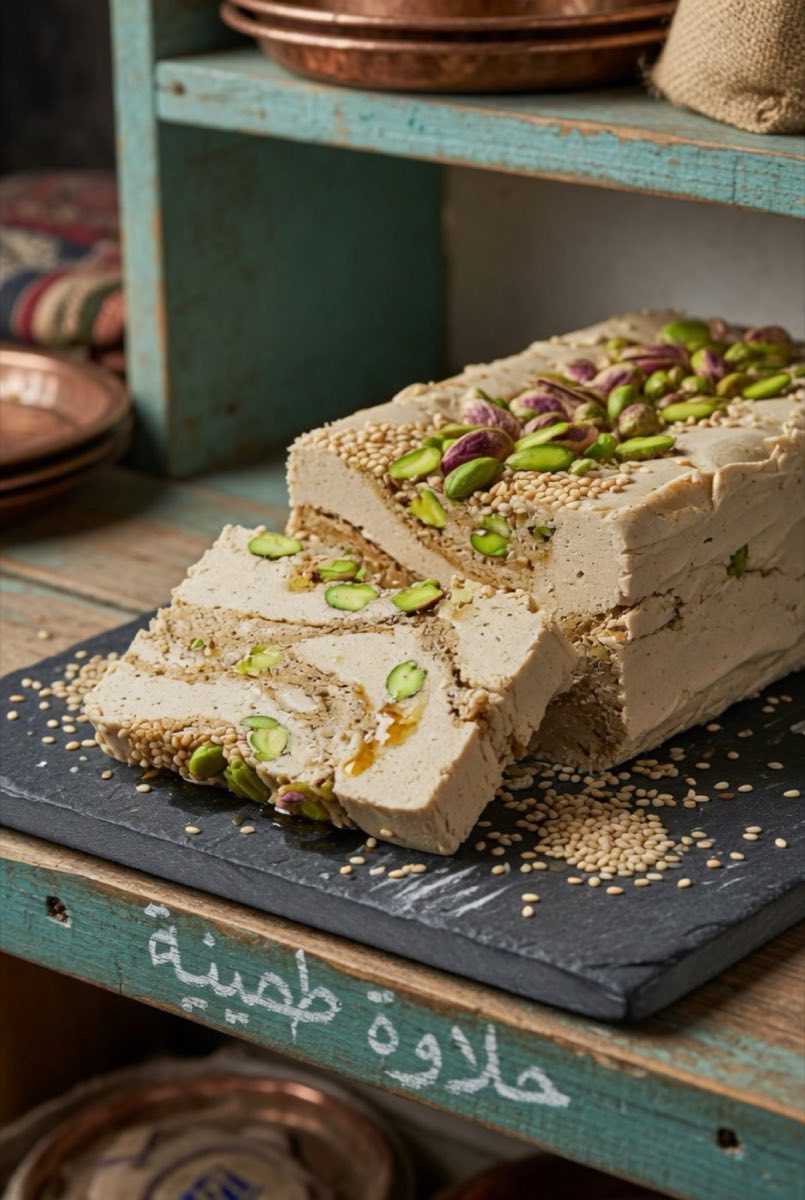
✓ Tested in Faten's kitchen
Silky, crumbly sesame paste halva with pistachios and a ribbon of Aleppo rose jam — the ancient sweet of the Syrian suq, made in Idlib from tahini pressed in the same stone mills that have been running since the Ottoman period.
⏱ 45 min🍽 16 servings📍 Idlib
Cook this hands-free
Every Sofra recipe is free to read here on the web. In the app, 112 recipes are free to cook in full, and membership opens the rest. The optional supporter upgrade unlocks the audio experience — step-by-step English narration (text-to-speech) — plus hands-free Cooking Mode and Charbel Rouhana's original oud music.
Get Sofra on Google Play →
Free download. Zero third-party ads. Ever.
The story
Halva tahinieh (sesame paste halva) is Syria's most important sweet and one of the oldest confections in the world — similar preparations appear in Byzantine cookbooks and are mentioned in medieval Arab culinary manuscripts. The city of Hama in Syria was once famous for its halva workshops (known as halwani), and the tradition migrated to Idlib with the families who settled there from Aleppo's sweet-making quarters. Idlib's version is distinguished by the quality of its sesame paste: the tahini pressed from sesame grown on the Idlib plateau has a lighter color and a milder, more delicate flavor than the darker Syrian tahini used in savory cooking, and this ingredient quality is what separates a great halva from an ordinary one. The technique of homemade halva — cooking a simple sugar syrup to a firm ball stage, then beating it rapidly into tahini to produce the characteristic crumbly-yet-smooth texture — is surprisingly accessible. Faten's family in Idlib makes halva for Eid al-Fitr and for weddings, pressing rose jam (mrabba ward) from their garden into the surface before it sets. The finished slab is wrapped in wax paper and distributed to guests — receiving a package of homemade halva from an Idlib family is a significant gesture of hospitality and respect.
Frequently asked questions
What is Halva Tahinieh — Idlib Sesame Paste Halva?
Silky, crumbly sesame paste halva with pistachios and a ribbon of Aleppo rose jam — the ancient sweet of the Syrian suq, made in Idlib from tahini pressed in the same stone mills that have been running since the Ottoman period.
Where is Halva Tahinieh — Idlib Sesame Paste Halva from?
Halva Tahinieh — Idlib Sesame Paste Halva comes from Idlib. Sofra documents this recipe as part of its 214-recipe Lebanese and Syrian heritage collection, including 49 dishes from Idlib province.
Is Halva Tahinieh — Idlib Sesame Paste Halva vegetarian or vegan?
As written, Halva Tahinieh — Idlib Sesame Paste Halva uses only plant-based ingredients, so it is suitable for both vegetarian and vegan diets. Always double-check the full ingredient list against your own dietary needs.
What can I use instead of lemon juice in Halva Tahinieh — Idlib Sesame Paste Halva?
The lemon juice called for here is part of the traditional recipe and gives Halva Tahinieh — Idlib Sesame Paste Halva its traditional character, so keep it if you can. If you must substitute, choose the closest equivalent you have on hand and adjust to taste — the dish will shift slightly from the traditional version but still work. The Sofra app lists the full ingredient set and sourcing notes.
What do I serve with Halva Tahinieh — Idlib Sesame Paste Halva?
In a Levantine desserts spread, Halva Tahinieh — Idlib Sesame Paste Halva is served at the end of a meal or with afternoon coffee or tea. A little extra syrup or nuts on top is traditional where the recipe calls for them.
Can I make Halva Tahinieh — Idlib Sesame Paste Halva ahead, and how do I store leftovers?
Most components can be prepared ahead. Store leftovers covered in the refrigerator and bring to room temperature before serving for the best texture; syrups and nut toppings are best added or refreshed close to serving.
Hear every step read aloud
Step-by-step audio narration (text-to-speech) guides you hands-free. Charbel Rouhana's original oud plays during Cooking Mode.
Get Sofra on Google Play →