✓ Tested in Faten's kitchen
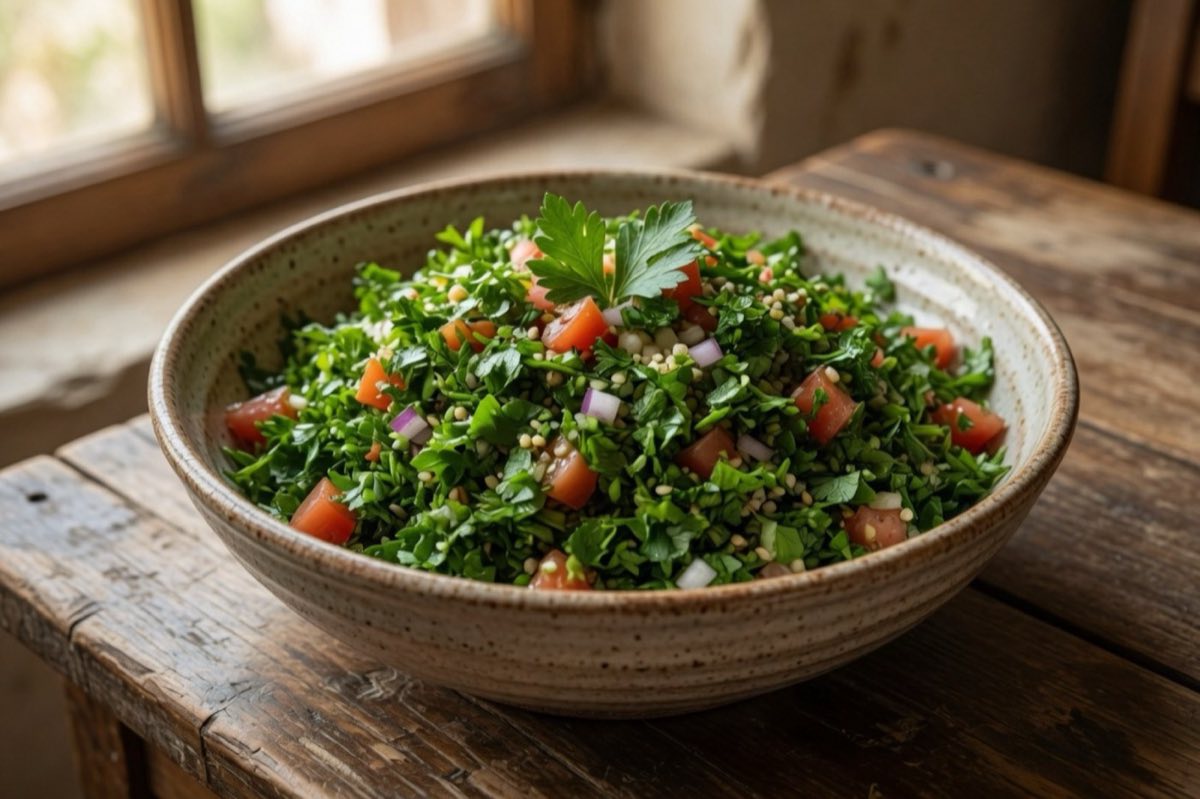
A vibrant herb salad of finely chopped parsley, mint, tomatoes, and bulgur, dressed with lemon and olive oil — Lebanon's most internationally recognized dish.
⏱ 30 min🍽 6 servings📍 Lebanese coast
Cook this hands-free
Every Sofra recipe is free to read here on the web. In the app, 112 recipes are free to cook in full, and membership opens the rest. The optional supporter upgrade unlocks the audio experience — step-by-step English narration (text-to-speech) — plus hands-free Cooking Mode and Charbel Rouhana's original oud music.
Get Sofra on Google Play →
Free download. Zero third-party ads. Ever.
The story
Tabbouleh is the most misunderstood dish in Lebanese cooking. Outside the country it is often served as a bulgur salad flecked with parsley; inside Lebanon it is a parsley salad flecked with bulgur — and the Lebanese Heritage Kitchen is uncompromising on the distinction. The proper ratio is roughly ten parts finely chopped flat-leaf parsley to one part fine bulgur, and the parsley must be chopped by hand with a very sharp knife, never in a food processor, which bruises the leaves and turns the salad wet and olive-drab. Tabbouleh is a coastal Lebanese dish that traveled inland: it was perfected in the restaurants of Beirut and the family kitchens of the Chouf mountains, where wild parsley grew along every terrace wall. On the mezze table it sits beside hummus, baba ghanouj, and fattoush, and it is never eaten with a fork — Lebanese families scoop it up with crisp romaine lettuce hearts or tear pieces of fresh khubz to use as edible spoons. In 2009 the Lebanese Ministry of Tourism organized the largest tabbouleh in the world — over 3,500 kilograms, prepared in Beirut on Achrafieh's Sassine Square — to reclaim the dish from the international confusion. A good tabbouleh tastes bright, lemony, almost aggressive; the salt must be assertive; and the olive oil must be the best the kitchen owns.
Frequently asked questions
What is Tabbouleh?
A vibrant herb salad of finely chopped parsley, mint, tomatoes, and bulgur, dressed with lemon and olive oil — Lebanon's most internationally recognized dish.
Where is Tabbouleh from?
Tabbouleh comes from Lebanese coast. Sofra documents this recipe as part of its 214-recipe Lebanese and Syrian heritage collection, including 49 dishes from Idlib province.
Is Tabbouleh vegetarian or vegan?
As written, Tabbouleh uses only plant-based ingredients, so it is suitable for both vegetarian and vegan diets. Always double-check the full ingredient list against your own dietary needs.
What can I use instead of allspice in Tabbouleh?
The allspice called for here is part of the traditional recipe and gives Tabbouleh its traditional character, so keep it if you can. If you must substitute, choose the closest equivalent you have on hand and adjust to taste — the dish will shift slightly from the traditional version but still work. The Sofra app lists the full ingredient set and sourcing notes.
What do I serve with Tabbouleh?
In a Levantine salads spread, Tabbouleh is served as a fresh side to grilled meats, roasted vegetables, or a mezze spread, and pairs well with warm bread.
Can I make Tabbouleh ahead, and how do I store leftovers?
Yes — leftovers keep well stored in an airtight container in the refrigerator for a few days. Reheat gently (or bring to room temperature for cold dishes) and taste to adjust seasoning before serving. Dishes with fresh herbs or dressing are freshest the day they are made.
Hear every step read aloud
Step-by-step audio narration (text-to-speech) guides you hands-free. Charbel Rouhana's original oud plays during Cooking Mode.
Get Sofra on Google Play →