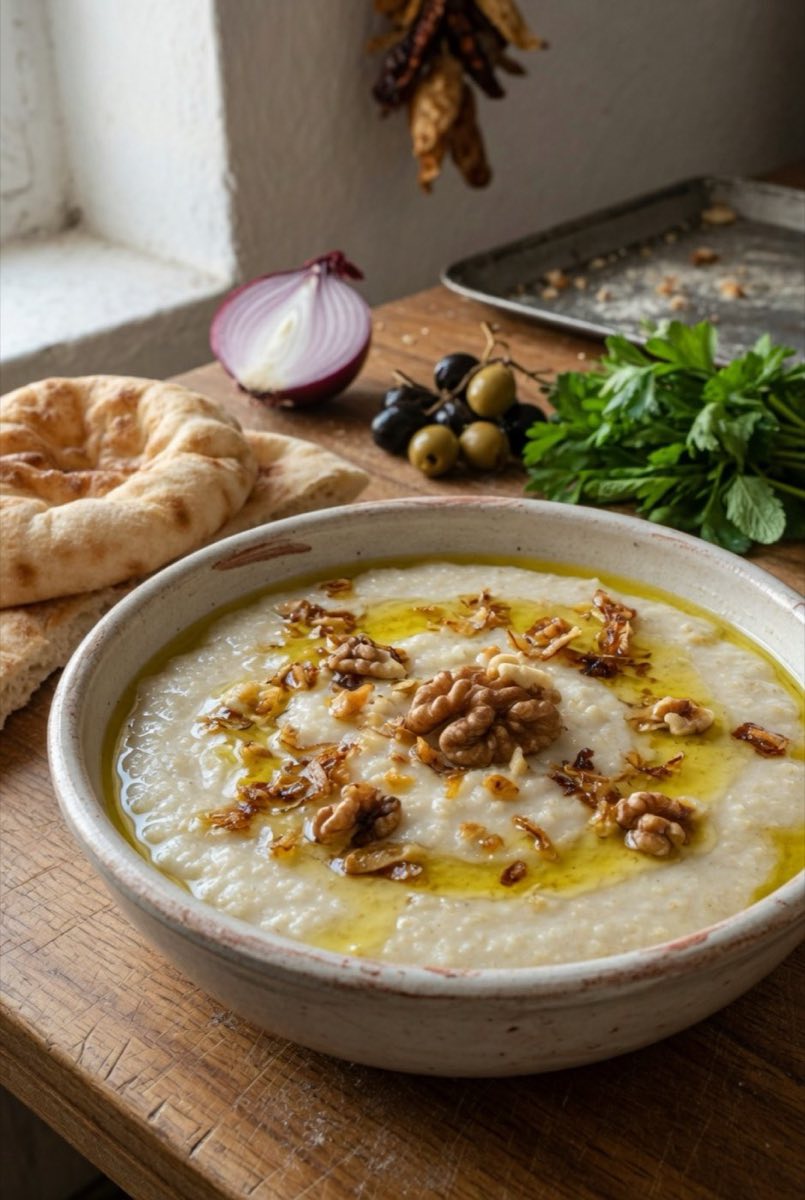
Cracked wheat fermented with yogurt, dried in sheets under the late-summer sun, then ground to a pale, chalky powder. Sour, creamy and intensely savoury at once — the mountain pantry's answer to winter.
Also known as kichk · keshek · kishik
- Arabicكشكkishk
- What it isCracked wheat fermented with yogurt, sun-dried and ground
- Looks likePale beige powder, fine and faintly gritty
- Made inLate summer — dried on rooftops through September
- KeepsThrough the winter, dry and cool, without refrigeration
The Ingredient Atlas, in your pocket
Every Sofra recipe is free to read here on the web. The app carries an Ingredient Atlas covering dozens of Levantine ingredients — in English, Arabic and Portuguese, with the name in French and Spanish too — alongside a free collection of 112 recipes to cook from.
Get Sofra — free download →On the
App Store and Google Play. Zero third-party ads. Ever.
What it tastes and smells like
Sour first — a deep, lactic sourness closer to an aged cheese than to fresh yogurt — with a wheaty, almost nutty body underneath it. Dry kishk smells faintly of a cheese cellar.
Cooked, it thickens and turns savoury, and the sourness settles into something nearer broth than dairy. It is not a seasoning you are tasting. It is a fermentation, and nothing on a spice shelf reproduces it.
Commonly shelved near the burghul and the dried pulses rather than with the spices.
How to buy and store it
Sold in Levantine and Middle Eastern groceries as a loose powder or in sealed bags, usually labelled kishk or kichk. Look for an even, pale beige. A grey cast or a sour-fat smell commonly means it has been kept too long.
Store it dry: an airtight jar in a cool cupboard, out of the light. Kishk was made to last a winter without refrigeration and behaves that way — but once opened, cook through it within the season rather than holding it for a second year.
The story
Kishk is made in late summer: cooked bulgur is mixed with yogurt and left to ferment for several days, then spread in thin layers on clean cloths to dry in the September sun, then ground to a powder and stored in cloth bags. The powder keeps all winter without refrigeration. In the Lebanese mountains, kishk porridge is breakfast on cold mornings, and it is what carried families through winters when fresh food was scarce.
Frequently asked questions
What is kishk?
Kishk is cracked wheat fermented with yogurt, dried in thin sheets in the sun and ground to a pale powder. It is one of the oldest fermented grain preparations of the Levant, made in late summer and eaten through the winter.
What does kishk taste like?
Deeply sour and savoury, with a lactic tang closer to aged cheese than to yogurt, over a wheaty body. Cooked, it thickens into a porridge or soup whose sourness reads more like broth than dairy.
Is kishk the same as Persian or Turkish kashk?
They share a name and a principle — dairy preserved by drying — but they are not the same preparation. Levantine kishk is fermented with cracked wheat and ground to a powder. Kashk in Iran and Turkey commonly refers to a dried or reconstituted whey product made without grain.
What can I use instead of kishk?
There is no true substitute; the sourness comes from a fermentation you cannot shortcut. The nearest approach is thick labneh loosened with stock, thickened with fine bulgur and sharpened with lemon.
How do I store kishk?
In an airtight jar in a cool, dark cupboard. Properly dried kishk keeps a whole winter without refrigeration. Once opened, use it through the season rather than holding it a second year.
What do you cook with kishk?
Most often a thick winter porridge with fried onion, garlic and olive oil, or a soup with lamb and caramelised onion. Sofra documents three kishk dishes, including the Idlib and South Lebanese versions.