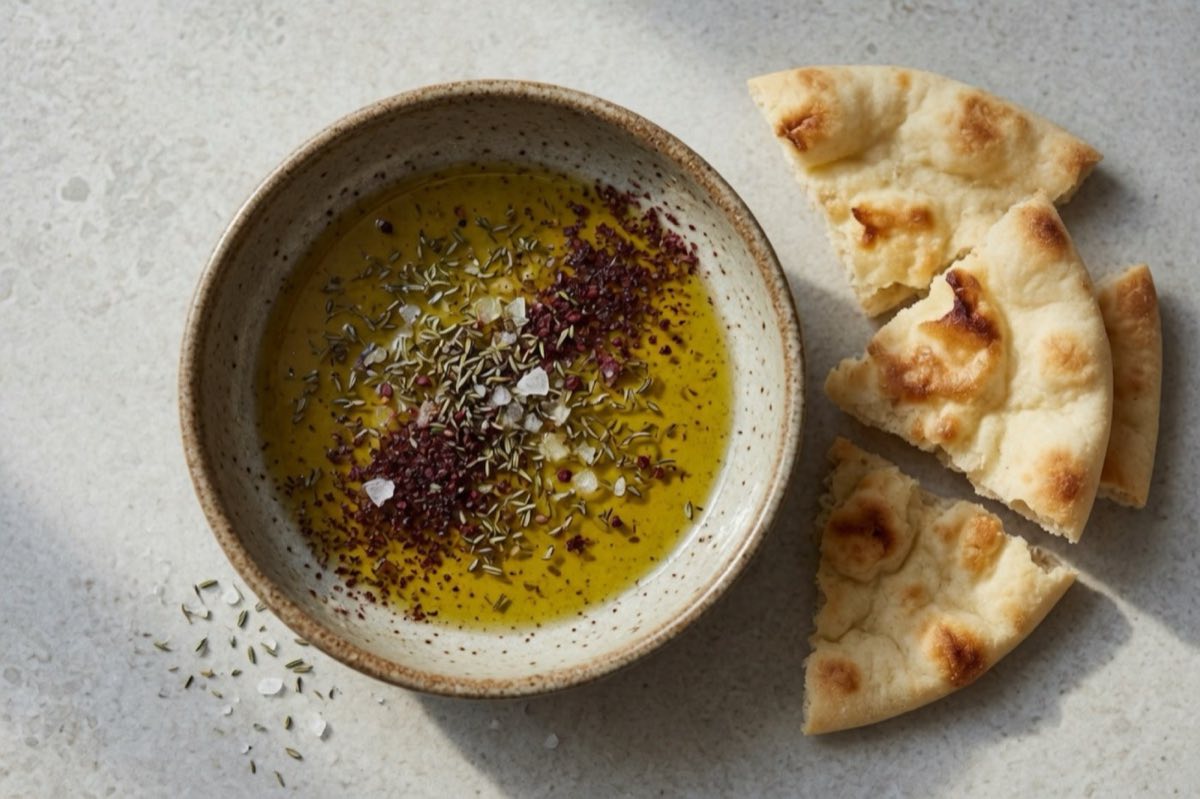
The structural fat of this kitchen — poured raw over hummus and labneh, cooked into stews, and set on the table in its own dish with bread beside it. It is not a background note here. It is tasted, and a whole family of dishes is named after it.
Also known as zayt al-zaytoun · zeit zaytoun · zeit · zayt
- Arabicزيت الزيتونzayt al-zaytoun
- What it isPressed olive fruit, unrefined in the grade that matters
- The gradeExtra-virgin for anything raw; refined only for high heat
- Buy onHarvest date, not expiry date
- TastesGrassy and green, with a peppery catch at the back of the throat
- KeepsAbout 18 months from harvest, sealed, cool and dark
The Ingredient Atlas, in your pocket
Every Sofra recipe is free to read here on the web. The app carries an Ingredient Atlas covering Olive Oil and dozens more Levantine ingredients — in English, Arabic and Portuguese, with the name in French and Spanish too — alongside a free collection of 112 recipes to cook from.
Get Sofra — free download →On the
App Store and Google Play. Zero third-party ads. Ever.
What it tastes and smells like
Green and grassy when it is fresh, finishing with a peppery catch at the back of the throat that can make you cough. That catch is the point — it comes from the polyphenols, and it fades as the oil ages. Oil that goes down smoothly with no bite behind it is old, whatever the label says.
In a dish named bil zeit — in oil — the oil is not the cooking medium but the seasoning, and the quantity in the recipe is not a mistake. Hindbeh bil zeit is chicory and onion carrying as much oil as it will take.
Which kind
- Extra-virgin, first cold pressThe only grade worth using raw, and the one every dish here assumes. Bright, grassy, peppery.
- Pure or light olive oilRefined and close to neutral. Acceptable for high-heat cooking and wrong for anything served at the table.
- Sorani, from the Idlib grovesAlso written Souri. Peppery, herbaceous, mineral, and commonly described as one of the oldest cultivated olive varieties. Rarely exported. If a grocer has it, buy it.
Buy the best you can afford for the bottle that goes on the table, and something cheaper for the pan. The two jobs are not the same.
How to buy and store it
Look for a harvest date on the bottle, not just a best-before date. A best-before date tells you when the bottler stopped guaranteeing it; a harvest date tells you how old the oil actually is, which is the thing that decides how it tastes. Anything more than about eighteen months past harvest has lost the peppery finish.
Buy dark glass or tin, never clear plastic, and never from a bottle that has been sitting under a shop light. Store it in a cupboard away from the stove — heat and light are what turn it, not time alone. Middle Eastern grocers often carry Lebanese and Syrian varietals that no supermarket stocks; it is worth asking rather than scanning the shelf.
The story
Olive oil is also a preservative here, and that is half of what the mouneh — the household larder — is built on. Labneh rolled into balls and covered with oil keeps for months. Baby eggplants stuffed with walnut and submerged in oil become makdous. The salt and the oil do the work together, and families judge one another's oil on how well the jars come through the winter.
IdlibThe olive trees of the Jabal al-Zawiya massif bordering Idlib province are among the oldest in the world — archaeologists excavating the nearby Byzantine “Dead Cities” of the limestone plateau have dated some specimens at over 3,000 years. Those groves have been harvested continuously through Roman, Byzantine, Umayyad, Abbasid and Ottoman rule, and they are still harvested now.
Frequently asked questions
Why does Lebanese and Syrian cooking use so much olive oil?
Because in this kitchen the oil is a flavour rather than a cooking medium. A whole family of dishes is named bil zeit — in oil — and in those the oil is the seasoning. The quantity a recipe calls for is deliberate.
What does good olive oil taste like?
Green and grassy, finishing with a peppery catch at the back of the throat that can make you cough. That catch comes from the polyphenols and fades as the oil ages, so an oil with no bite behind it is old.
Should I buy on the harvest date or the expiry date?
The harvest date. An expiry date only tells you when the bottler stopped guaranteeing the oil. The harvest date tells you how old it actually is, and past roughly eighteen months the peppery finish is gone.
What is the difference between extra-virgin and light olive oil?
Extra-virgin is unrefined and carries all the flavour; it is what every dish here assumes and the only grade to use raw. Light or pure olive oil is refined and close to neutral — acceptable in a hot pan, wrong on the table.
What is Sorani olive oil?
Sorani, also written Souri, is the olive variety grown in northwestern Syria including the Idlib groves. The oil is peppery, herbaceous and mineral, and the variety is commonly described as one of the oldest still cultivated. It is rarely exported.
How should I store olive oil?
In dark glass or tin, in a cupboard away from the stove. Heat and light turn oil faster than time does, which is why a clear bottle under a shop light is a bad buy however good the oil started out.